
Artificial Intelligence (AI) is revolutionizing the AEC sector. The building information modeling process is revolutionizing the design process of buildings and infrastructure construction projects. In 2026, the integration of AI and BIM will transform digital construction in many ways.
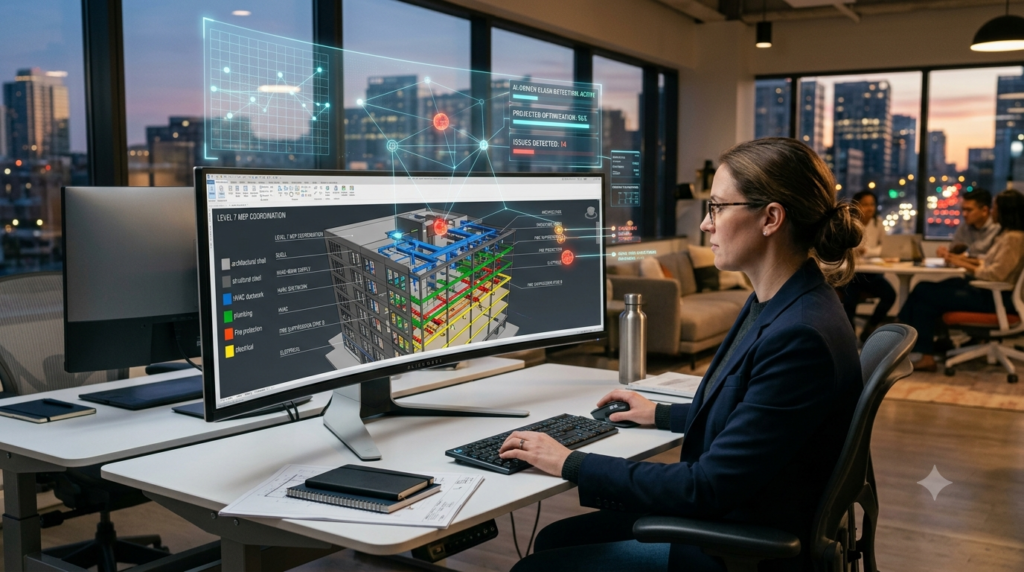
In the year 2026, the use of AI in AEC helps AEC professionals automate BIM processes, analyzes data related to projects, coordinates models, detects any issue, and takes project-related decisions.
The use of AI in the field of BIM does not involve the replacement of BIM experts.
Instead, it involves an advanced BIM workflow process wherein AI works hand-in-hand with architects, engineers, BIM coordinators, contractors, and project managers.
Here, we will explore how AI is changing BIM in 2026, the implications for BIM automation and BIM coordination, BIM careers in 2026, and skills for BIM professionals.
What Is AI in BIM?
“I” in BIM stands for using artificial intelligence, machine learning, computer vision, natural language processing, and data-driven algorithms to enhance BIM processes.
Conventional BIM practices often involve professionals doing the following things manually:
- Creating and altering models
- Checking models’ information
- Finding clashes
- Reviewing projects’ data
- Creating reports
- Resolving coordination issues
- Comparing design information
- Quantifying data
- Verifying project requirements
AI may help with many of such routine tasks.
Not replacing the BIM process, but making it quicker and more automated with the help of data.
Conventional BIM Process
Modeling → Checking → Coordination → Finding Issues → Creating Reports → Resolving Issues
AI-assisted BIM Process
Modeling → AI Analysis → Automated Checking → Prioritizing Issues → Human Decision-making → Resolving Issues
The human professional will still be responsible for engineering decision-making.
1. AI Helps to Automate Repetitive BIM Activities
Another major benefit of AI is automation.
BIM specialists often engage in repetitive tasks like:
- Renaming elements
- Checking parameters
- Verifying information of the model
- Generating reports
- Model properties verification
- Information search
- Data organization
- Comparing model versions
Both AI and automation can contribute to decreasing the number of manual activities.
For instance, rather than verifying parameters for all BIM elements by hand, an automatic approach will help to find elements requiring attention.
This way, more time can be spent on solving complicated issues.
2. AI is Enhancing Clash Detection and Coordination
Clash detection is one of the most significant BIM coordination processes.
Existing clash detection systems are able to find geometric clashes between various disciplines.
For example:
- HVAC duct clashing with structural beam
- Plumbing pipe clashing with electrical cable tray
- Fire sprinkler clashing with ceiling
- Mechanical equipment clashing with architectural wall
But there could be thousands of clashes in a single project.
The difficulty is not only to find clashes but also to figure out:
– Which clashes are significant?
Artificial intelligence could play a role in classifying coordination issues using criteria such as:
- Severity
- Location
- Discipline
- Impact on
- construction process
- Repetition
- Clearance
- Project priorities
3. AI Can Assist in Automated Model Checking
The quality of the model is important for successful BIM delivery.
Some of the issues that can be detected using AI-assisted process include:
Parameters missing
Wrong element data
Naming issues
Duplicated elements
Wrong classification
Incomplete data
Standard violation
Geometric inconsistency
Rather than conducting a manual examination of the whole model, people can run some automated tests and spot problematic areas.
It will allow them to increase the quality of the model and its BIM compliance.
4. The Value of BIM Data is Enhanced by AI
A BIM model is more than just a three-dimensional depiction of the building.
It has information about:
- Material
- Equipment
- Component
- Dimension
- Quantity
- Manufacturer
- Specification
- System
- Location
- Relation
An AI system can analyze such information and provide insights.
5. AI + Revit Automation
Revit is a common tool that allows BIM creation within architectural, structural, and MEP practices.
AI will be able to help with repetitive activities and processes in Revit as well.
Automation may be created using various technologies like:
- Dynamo
- Python
- Revit API
- Visual programming
- Scripting with AI support
- External data processing workflows
In other words, a team of BIM experts will be able to automate:
Manual process:
Model opening → Element finding → Parameter checking → Data correction → Report generation
Automated process:
Script running → Model analysis → Problem detection → Report generation → Report review
A professional manages a process, while automation saves time.
6. AI Is Transforming BIM Coordination Meetings
Many of these meetings revolve around the discussion of many issues.
This is because AI can help categorize coordination information like this:
- Critical issues
- Architectural issues
- Structural issues
- MEP issues
- Repeatable issues
- Pending issues
- High-priority issues
Also, AI can help people understand what was different between coordination meetings.
This would make meetings much more focused.
For instance, instead of spending the bulk of the meeting talking about each and every single issue, people could spend time making decisions.
7. AI Can Help in Design Optimization
AI is also having an impact on the process of designing.
Using AI-based processes, various design options could be assessed against a set of criteria.
The criteria for different applications would include:
- Energy efficiency
- Spatial use
- Material efficiency
- Cost
- Structural efficiency
- Light
- Carbon footprint
- Buildability
Thus, the process shifts from:
Design → Model → Analysis
to:
Design → Generation of Options → Analysis → Comparison → Optimization
While BIM provides a project-oriented environment, AI can assist in the analysis and comparison of various options.
8. AI and Scan-to-BIM
There are also new opportunities being presented by AI in the Scan-to-BIM process.
Point clouds obtained from laser scanning have millions of points.
Traditionally, those involved in BIM need to make sense of these point clouds and model existing elements within buildings.
Through AI and computer vision, one can detect various objects such as:
Walls
Floors
Columns
Doors
Windows
Pipes
Ducts
Structure parts
This will lead to an effective process as follows:
Laser Scan → Point Cloud → AI Detection → BIM Modeling → Human Verification
The latter is still very critical as there may be anomalies within actual buildings.
Conclusion
AI is transforming BIM in 2026 by introducing new possibilities for automation, coordination, model checking, data analysis, design optimization and construction planning.
The goal is not simply to automate BIM professionals out of their jobs.
The real opportunity is to make BIM professionals more productive.
The BIM professional of the future will need more than software knowledge. They will need to understand BIM processes, engineering principles, automation, data and AI.
Frequently Asked Questions
1. What is AI in BIM?
AI in BIM refers to using artificial intelligence, machine learning, computer vision and automation to improve BIM processes such as model checking, coordination, data analysis and design optimization.
2. How is AI changing BIM in 2026?
AI is helping automate repetitive tasks, analyze BIM data, support clash detection, prioritize coordination issues, improve model checking and assist with design and construction decisions.
3. Can AI replace BIM Coordinators?
AI can automate some BIM coordination tasks, but BIM Coordinators still provide design understanding, construction knowledge, communication and professional judgment.
4. Is BIM still a good career in 2026?
Yes. BIM is evolving alongside AI, automation, cloud collaboration and digital twins. Professionals who combine BIM skills with automation and AI knowledge can access emerging opportunities.
5. Should BIM professionals learn Python?
Yes. Python can be valuable for BIM automation, data processing, reporting and API-based workflows.
6. Is Dynamo useful for BIM automation?
Yes. Dynamo can automate many repetitive Revit tasks and is an important skill for BIM professionals interested in computational workflows and automation.
7. What skills should a BIM professional learn in 2026?
A strong skill set includes Revit, Navisworks, Autodesk Construction Cloud, BIM coordination, Dynamo, Python, BIM standards, data management and AI-assisted workflows.
8. What is the future of BIM?
The future of BIM is increasingly connected with AI, automation, cloud collaboration, digital twins, data analytics, 4D/5D workflows and intelligent construction technologies.
Contact Us
Phone : +9191451 51694
E-mail : contact@matrix-designs.com